
Guide
Your students are Gen Z. Here's how they actually want to learn
Shorter cues, faster feedback and a reason for every drill. A teacher's guide to keeping Gen Z dancers, yogis and lifters locked in.
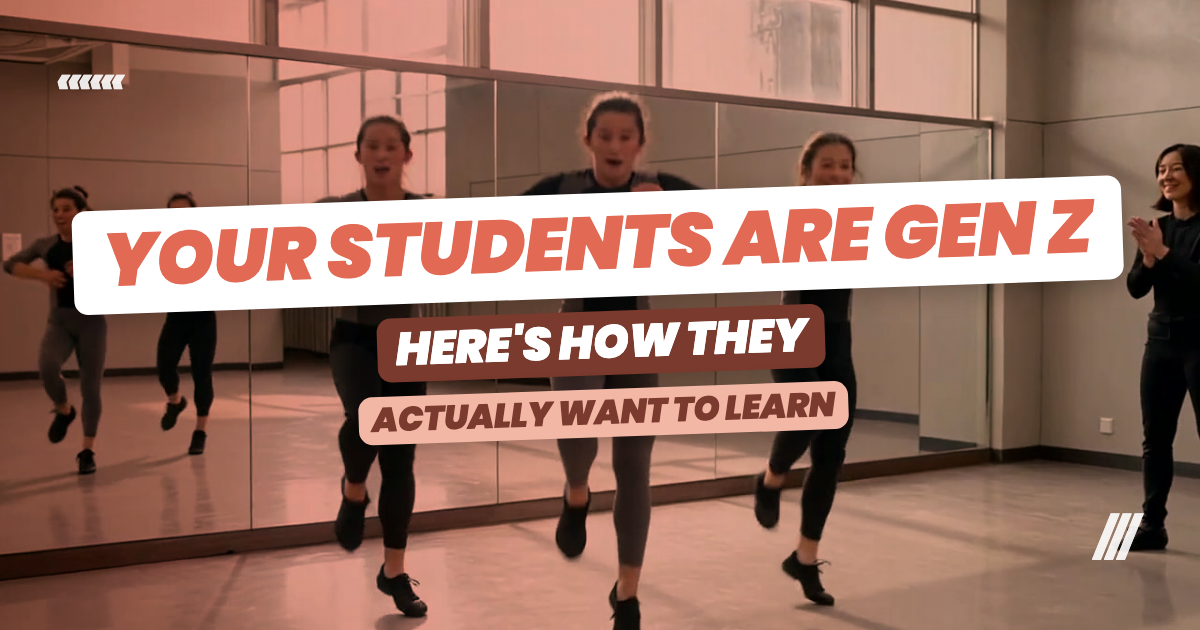
You count it in. Five, six, seven, eight. By the second eight-count, someone in the back is already asking if they can film it "for practice." Welcome to teaching Gen Z, the students who grew up learning moves from fifteen-second videos and expect to understand the point of everything in about that long.
The good news: they are curious, quick, and genuinely want to get better. They just learn differently than the classes many of us grew up in. Here is what actually works in the studio, on the mat and on the gym floor.
They learned to move from short videos, so teach in short pieces
Long demos lose the room. Break choreography, flows and sets into small chunks, teach one, run it, then stack the next. Each chunk should be short enough that a student can picture it with their eyes closed.
Give them the why, fast
"Because I said so" never landed, and it lands even less now. One sentence of why changes everything: this drill builds the core strength your turns need; this hold protects your lower back; this conditioning set is why your leaps will look effortless in May.

Learn a little of the language (and do not overdo it)
You do not need to sound like your students. You just need to know a compliment when you hear one. A quick cheat sheet:
- "That ate" means it went really, really well. Take the win.
- "It's giving…" means it has a certain vibe. Usually a good one.
- "No cap" means they are being sincere. Believe them.
- "Lowkey" means quietly, or a little bit. "Lowkey sore today" is useful information.
They do not need you to be cool. They need you to be clear, quick and real.
Make feedback fast, specific and private when it counts
Gen Z students want feedback, they just want it to be useful. "Good job" is noise. "Your arms finally matched the count on that last run" is gold. Save bigger corrections for a quick one-on-one moment instead of calling someone out in front of the whole room.
Your takeaway for Monday's class
- Chunk itTeach in pieces short enough to picture, then stack them.
- Lead with the whyOne sentence on what each drill or hold is for.
- Feedback in secondsSpecific, kind and immediate. Big corrections go one-on-one.
- Leave room to own itGive a few counts or one pose where they can add their own style.
- Close the loop between classesA short note about what to practice beats a long email nobody reads.
Keep the conversation going between classes
Short, friendly updates fit the way this generation already communicates. With Dominion, studios can message families and send push notifications through the Studio App, available on iOS and Android, so a quick "practice that second eight-count this week" actually gets seen.
Questions
Teach in short, clear chunks, explain why each drill matters, give quick specific feedback, and leave a little room for students to make the move their own.
Related
- Guide
Parent communication for dance studios
How to keep dance families informed without endless texts: announcements by push and email, group and direct messages, and one place for updates.5 min read - Guide
Dance studio attendance: how to track it and why it matters
How to take attendance for dance classes and events, which statuses to use, how to handle makeups, and how attendance helps you keep dancers.5 min read
See your studio on Dominion.
Start free, or watch the tour.